

DATE
November 20, 2025
In a world of AI-powered attacks, zero-day exploits, and ransomware-as-a-service, it's frustrating that the most exploited entry point is still basic credential abuse. According to the 2025 Verizon Data Breach Investigations Report (DBIR), stolen or compromised credentials were the initial access vector in 22% of breaches—second only to vulnerability exploitation (20%)—and played a role in the majority when combined with phishing and social engineering.
This isn't a niche issue: attackers succeed because weak and reused passwords provide the path of least resistance. Infostealer malware now harvests credentials at scale, fueling credential stuffing and ransomware. Let's dive into why this persists, the massive costs involved, and proven ways to fix it.
NordPass's latest 2025 research, analyzing billions of leaked credentials from breaches and the dark web, shows predictable patterns still dominate. Here's the global top 10:
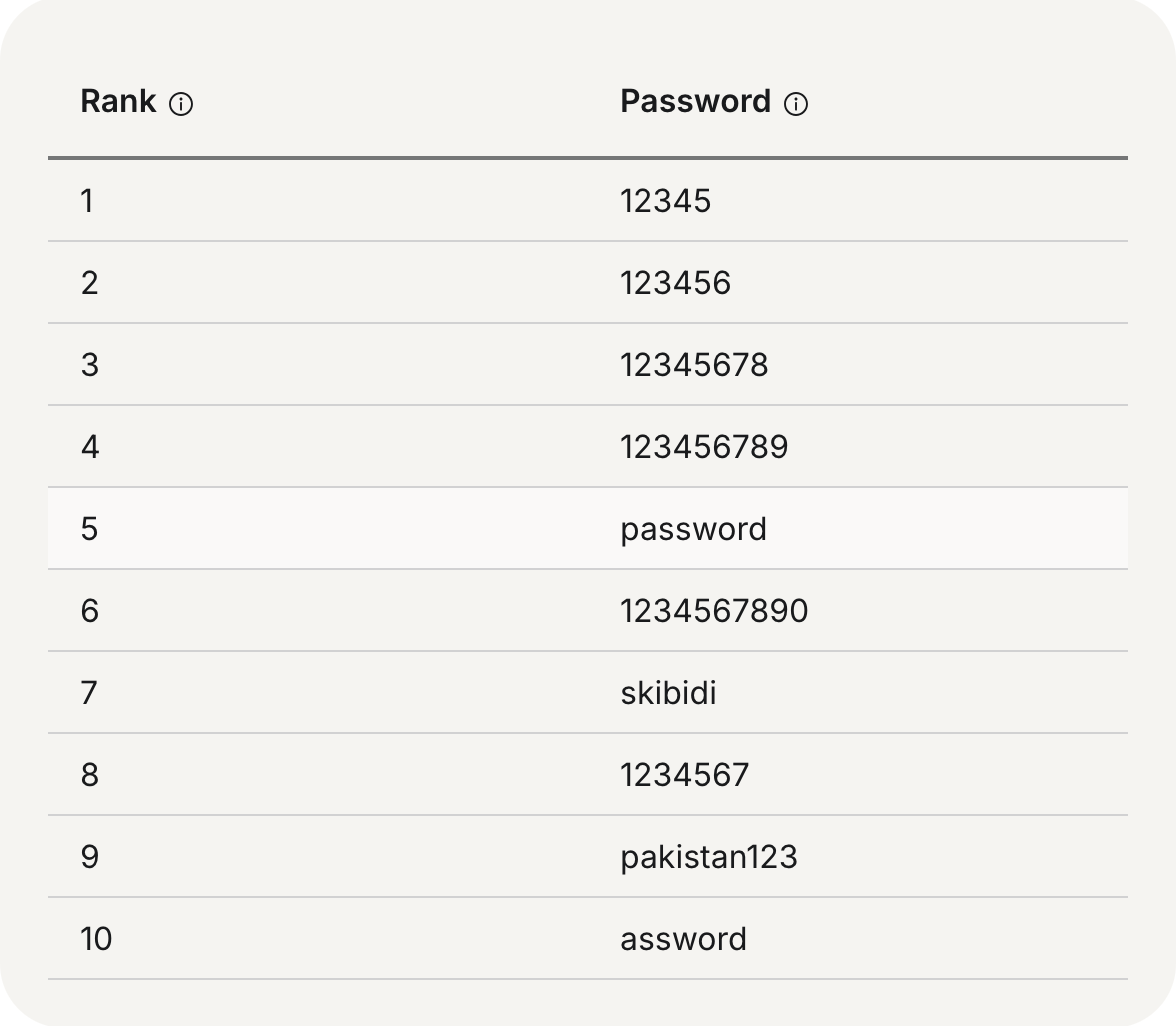
These appear in infostealer logs and dark web markets daily. With modern tools cracking billions of guesses per second, anything short, sequential, or dictionary-based falls instantly. Worse: 94% of leaked passwords are reused across accounts, turning one breach into a cascade.
IBM's 2025 Cost of a Data Breach Report pegs the global average breach cost at $4.44 million—down slightly due to better detection, but incidents involving stolen credentials take longer to identify (often 240+ days) and cost more overall.
Key fallout includes:
- Financial Damage — Forensic investigations, ransom payments (when paid), and recovery efforts skyrocket.
- Downtime and Disruption — Ransomware groups like LockBit often start with valid credentials, encrypting systems for weeks.
- Reputation Loss — Customer churn can exceed 30% post-breach; regulatory fines under GDPR/CCPA add millions.
- Third-Party Risks — Breaches via vendors doubled, frequently from reused credentials.
Verizon notes 54% of ransomware victims had exposed credentials in infostealer logs beforehand—proving prevention beats reaction.
The fix is straightforward and effective: stop relying on human memory. Enterprise password managers eliminate weak/reused passwords entirely:
1. Generate Truly Random Passwords → 30–64+ character strings like `x9#kL2@mP$qW7!vE8&zR` for every site.
2. Zero-Knowledge Encryption → Credentials stored securely; only accessible with your master (or biometric).
3. Automated Sharing & Controls → Revoke access instantly during offboarding; audit usage.
4. Breach Detection → Flags weak, reused, or exposed passwords proactively.
5. Passkey Support → Transition to phishing-resistant FIDO2 credentials where available—no passwords at all.
Combined with MFA (preferably hardware keys or passkeys over SMS), this reduces credential risk by over 90%.
Reactive security—cleaning up after breaches—is outdated and expensive. Shift to prevention:
1. Enforce Robust Policies — Require 16+ characters, block common/weak passwords, scan Active Directory for breached ones.
2. Mandate Phishing-Resistant MFA — Everywhere, especially privileged accounts.
3. Train Relentlessly — Simulate attacks; teach recognition of infostealer risks.
4. Go Passwordless — Adopt passkeys for consumer-facing and internal apps.
5. Monitor the Dark Web — Alert on exposed corporate credentials in real time.
6. Embrace Zero Trust — Never assume trust; verify every login.
In 2025, attackers aren't "hacking in"—they're logging in with credentials users handed them through laziness or reuse. Verizon and IBM data confirm: weak/stolen passwords enable most damage.
The tools to end this exist today. Deploy a password manager with passkey support, enforce strong policies, and monitor exposures. Your competitors who ignore this will become headlines—you don't have to.
Ready to close the credential gap? Start with a quick audit of your current passwords and MFA coverage. The threat landscape won't wait—secure your logins now.
Know the risk.
Stop the threat.
Stay Protected.
© 2026 red sentinel IT - License
Powered byRed sentinel it

%20thumbnail.png)
